Custom Optical Beam Splitters & Half-Silvered Mirrors (50/50, 30/70 & 70/30)
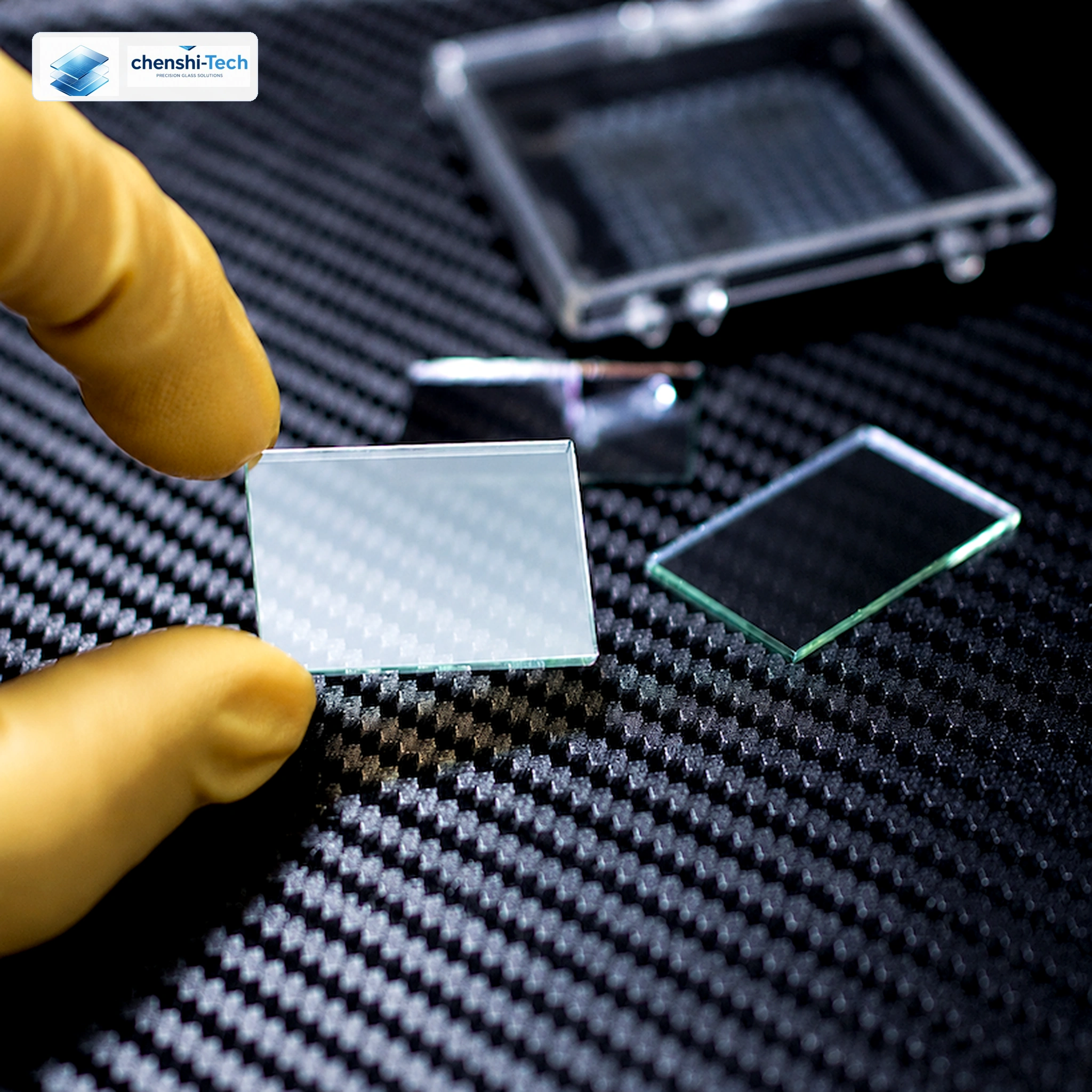
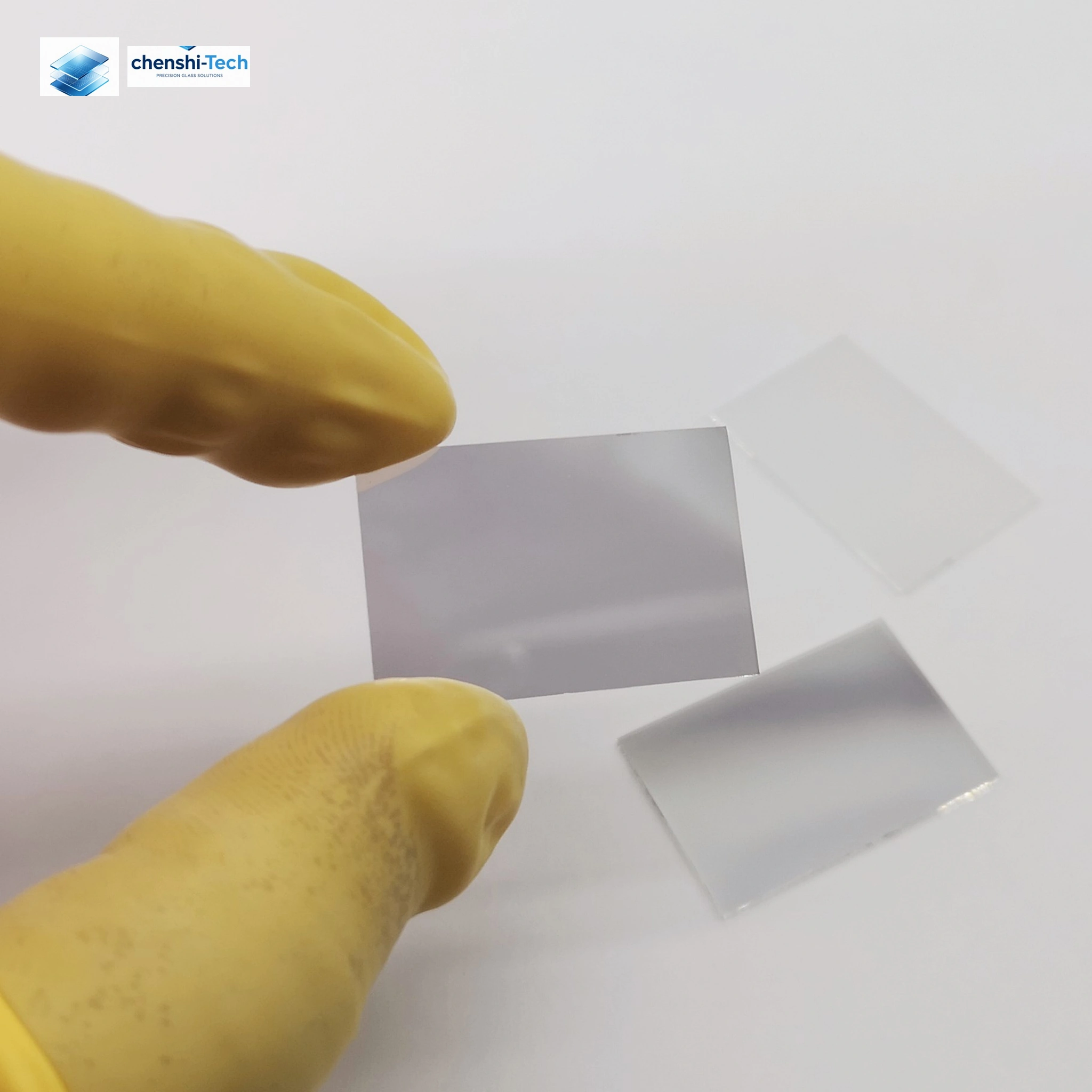
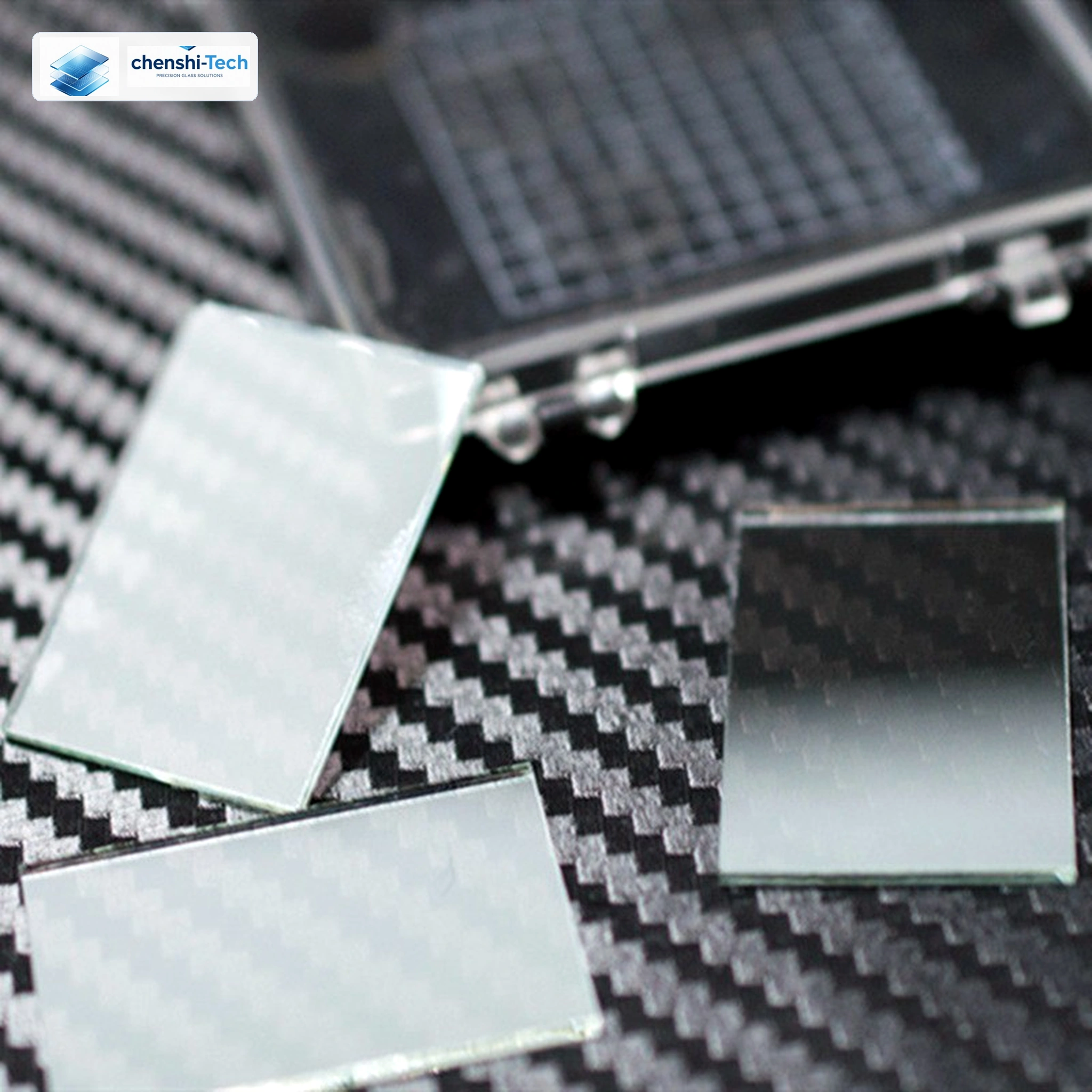
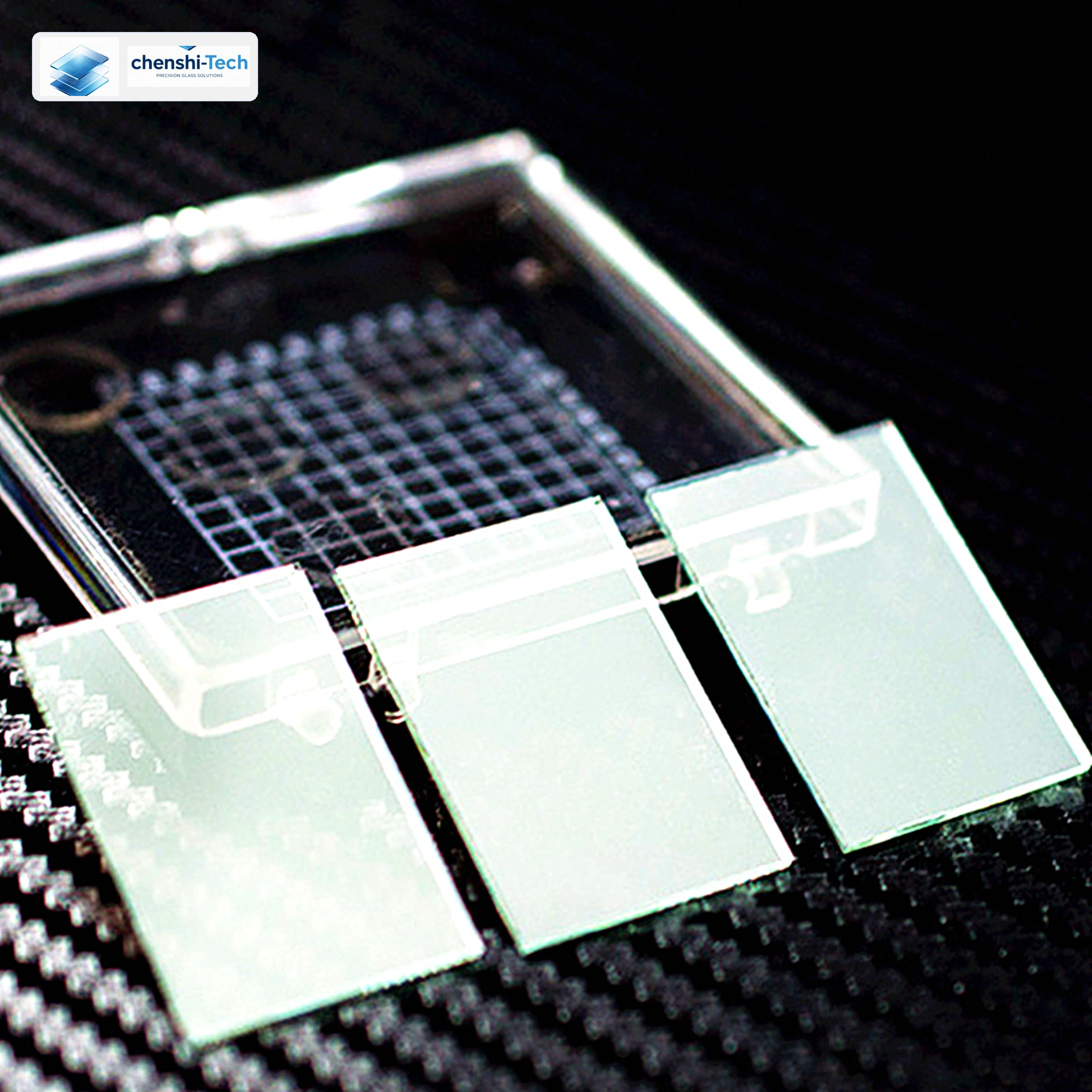
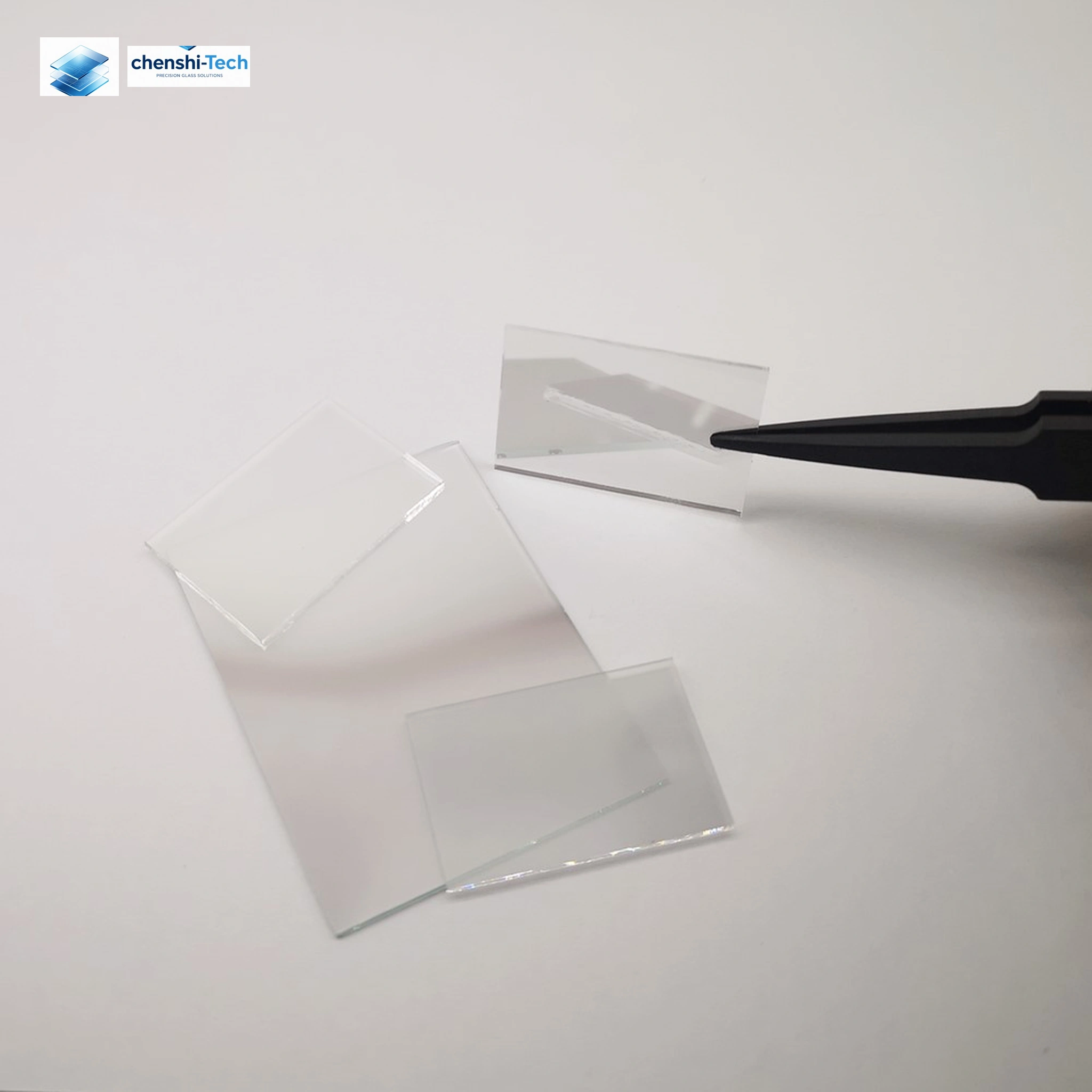
Chenshi Tech is a specialized manufacturer providing precision CNC fabrication and vacuum thin-film deposition for custom optical beam splitters and half-silvered mirrors. Engineered to divide an incident light beam into defined reflected and transmitted optical paths, our plate optical beam splitter components deliver calibrated Reflection-to-Transmission (R:T) ratios across ultraviolet (UV), visible (VIS), and near-infrared (NIR/SWIR) spectrums.
Manufactured on double-sided polished B270, N-BK7 (K9), or high-purity JGS1 fused silica optical windows, our beam splitters feature ultra-flat optical surfaces (up to lambda/10) paired with high-efficiency Broadband Anti-Reflective (BBAR) rear-surface coatings. Complementing our custom AR coating glass panels, we supply both low-loss all-dielectric coatings and broadband metallic-dielectric hybrid films tailored to your exact wavelength band and Angle of Incidence (AOI).
Technical Specifications: Plate Optical Beam Splitters
Every production lot undergoes spectrophotometric reflectance/transmittance verification and Zygo laser interferometry flatness inspection prior to shipment. Optical surface quality and coating durability adhere to MIL-PRF-13830B, MIL-C-675C, and ISO 10110 specifications.
| Optical & Physical Parameter | Standard Engineering Specification | Custom & Laser-Grade Options |
|---|---|---|
| Product Name | Custom Plate Optical Beam Splitter / Half-Silvered Mirror | Cube or wedged plate configurations |
| Splitting Ratio (R : T) | 50:50, 30:70, 70:30, 20:80, 80:20, 10:90 (±3% to ±5%) | Custom ratio from 5:95 to 95:5 |
| Operating Wavelength Bands | 400–700 nm (VIS), 700–1100 nm (NIR), 1100–1700 nm | Single laser lines (532nm, 632.8nm, 808nm, 1064nm, 1550nm) |
| Angle of Incidence (AOI) | 45° ± 2° (Standard diagonal beam splitting) | Custom calibrated for 0° to 60° AOI |
| Polarization Control | Non-Polarizing (NPBS, low P/S separation) or Random | Polarization-Sensitive Dielectric (PBS) |
| Substrate Base Material | Optical B270 / N-BK7 (K9) Crown Glass | UV Fused Silica (JGS1 / JGS2) / Borosilicate 3.3 |
| Backside Coating | Broadband Anti-Reflective (BBAR, R < 0.5%) | Single-wavelength V-Coat (R < 0.1%) |
| Surface Flatness | lambda/4 per 25 mm @ 632.8 nm | lambda/10 interferometry reference grade |
| Surface Quality (Scratch-Dig) | 40-20 standard optical grade | 20-10 / 10-5 laser grade |
| Parallelism / Wedge Angle | < 30 arcseconds (Parallel plate) | Intentional 30 arcminute wedge to eliminate ghosting |
| Standard Dimensions & Thickness | Dia. 12.7 mm, 25.4 mm, 50 mm; Thickness 1.0–3.0 mm | Custom squares, rectangles & discs (3–300 mm; 0.3–10 mm) |
| Dimensional Tolerance | ±0.05 mm (Precision CNC diamond edging) | Ultra-tight tolerance down to ±0.02 mm |
| Coating Durability | Hard dielectric / protected hybrid film (MIL-C-675C) | Passes tape adhesion, abrasion & thermal humidity tests |
Measured Spectral Performance (50:50 Optical Beam Splitter)
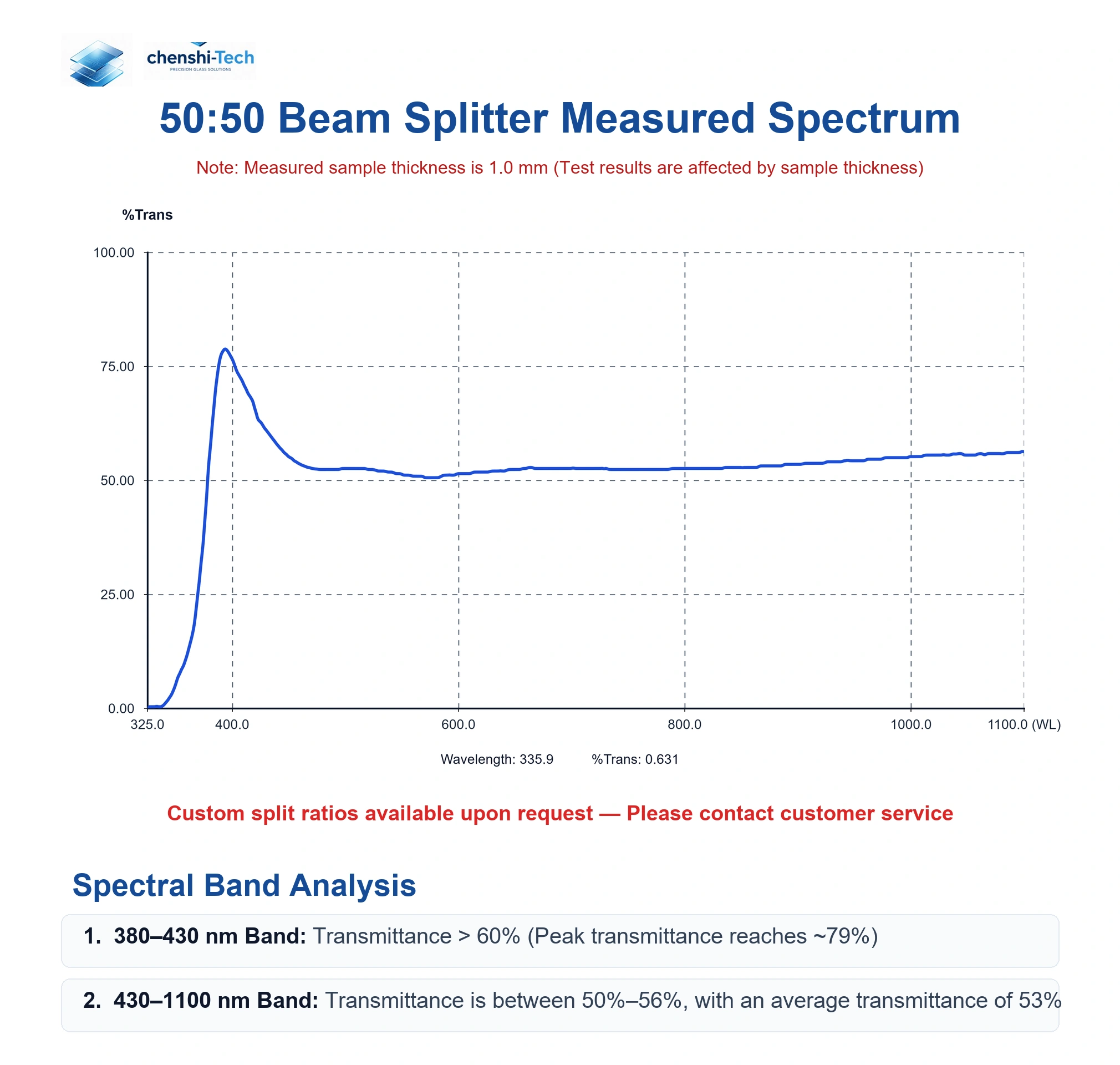
To verify real-world splitting accuracy, every production batch is tested on a calibrated UV-Vis-NIR spectrophotometer. The measured transmission curve above demonstrates the baseline optical performance of a standard 1.0 mm thick 50:50 optical beam splitter across the 325 nm to 1100 nm spectrum:
- 430–1100 nm Working Band (VIS to NIR): Maintains a highly flat, uniform transmittance profile between 50% and 56%, achieving an average transmittance of 53% across the visible and near-infrared regions.
- 380–430 nm Transition Band: Exhibits elevated transmission above 60% (with a peak reaching approximately 79% near 400 nm).
- Custom Spectral Calibration: Splitting ratios (such as 30:70, 70:30, or 20:80) and operational bandwidths can be tailored to your exact substrate thickness and Angle of Incidence (AOI). Full CSV/PDF spectrophotometer data files are supplied with every shipment.
Key Engineering Advantages
- Ghost-Free Optical Imaging: Secondary reflections from the rear glass face create double images and phase noise in optical sensors. We deposit a multi-layer BBAR coating (R < 0.5%) on the non-splitting rear surface—and optionally machine a 30-arcminute optical wedge—to completely eliminate ghost reflections.
- Low-Absorption All-Dielectric Thin Films: Conventional bare metallic half-mirrors absorb 10% to 15% of incident light energy. Our electron-beam and Ion-Assisted Deposition (IAD) all-dielectric stacks achieve near-zero optical absorption (R + T > 99%), preserving maximum photon throughput in low-light fluorescence and high-power laser systems.
- Environmental & Mechanical Resilience: Deposited under high-vacuum ion assistance, our dense oxide layers resist moisture shift, oxidation, and mechanical wiping, meeting MIL-C-675C durability benchmarks across -40°C to +85°C operating temperatures.
Dielectric vs. Metallic-Dielectric Beam Splitter Selection
- All-Dielectric Plate Beam Splitters: Constructed from alternating high- and low-refractive-index oxide layers (such as TiO2 and SiO2). Recommended for single laser wavelengths or defined spectral bands where near-zero absorption loss, high laser damage thresholds (LDT), and steep spectral edges are critical.
- Hybrid Metallic-Dielectric Half Mirrors: Combines an ultra-thin silver or inconel layer capped with protective dielectric films. Ideal for ultra-broadband white-light applications (e.g., 400 nm to 1700 nm simultaneously) requiring flat splitting ratios and low polarization sensitivity across wide viewing angles.
Primary Industrial & Photonic Applications
- Laser Systems & Interferometry: Michelson and Mach-Zehnder interferometers, laser beam sampling, power monitoring taps, and optical bench alignment.
- Machine Vision & Coaxial Illumination: Coaxial telecentric lighting systems for semiconductor wafer inspection, PCB scanning, and specular surface defect cameras.
- Biomedical & Life Science Instruments: Fluorescence microscopy, optical coherence tomography (OCT), flow cytometers, and ophthalmic diagnostic devices.
- AR / HUD & Optical Combiners: Automotive head-up display (HUD) combiners, optical viewfinders, broadcast teleprompter mirror glass, and smart optical sensors.
Custom Fabrication, Prototyping MOQ & Quality Verification
- Agile R&D Prototyping MOQ: We support university photonics labs, optical hardware startups, and OEM engineering teams with rapid sample prototyping starting from 5 to 10 pieces, scaling seamlessly to volume production.
- Precision CNC Geometry & Edge Finishing: Custom circular discs, 45-degree elliptical projection mirrors, stepped sensor plates, ultrasonic drilled mounting holes, and 45-degree protective edge chamfers.
- Certified Metrology Reports: Every shipment includes measured spectrophotometer reflection/transmission curves, dimensional inspection records, and RoHS/REACH compliance documentation.
Frequently Asked Questions (FAQ)
Q: What parameters do I need to provide for a custom optical beam splitter quote?
A: Please specify five core parameters: (1) Target Reflection-to-Transmission ratio (e.g., 50:50 or 30:70), (2) Working wavelength or spectral band (e.g., 430–1100 nm or 1064 nm), (3) Angle of Incidence (typically 45 degrees), (4) Substrate material (B270, N-BK7, or Fused Silica) and dimensions/thickness, and (5) Whether backside AR coating is required.
Q: How do you prevent ghost reflections on a plate beam splitter?
A: Ghost images occur when light reflects off the uncoated rear face of the glass plate. We eliminate this by applying a Broadband Anti-Reflective (BBAR) coating on the rear surface (reducing rear reflection below 0.5%) or by grinding a slight optical wedge (typically 30 arcminutes) so the secondary reflection exits outside the clear aperture.
Q: When should I choose Fused Silica (JGS1/JGS2) over B270 or N-BK7 for a beam splitter?
A: B270 and N-BK7 optical glasses are cost-effective and well-suited for visible and near-infrared applications (400–2000 nm). UV Fused Silica (JGS1/JGS2) is recommended for deep-UV wavelengths (< 350 nm), high-power pulsed lasers requiring high laser damage thresholds, and environments demanding ultra-low thermal expansion.
Q: Do you support small-quantity R&D prototypes with test curves?
A: Yes. Our Minimum Order Quantity (MOQ) for custom prototypes starts at 5 to 10 pieces, and every batch ships with its measured spectrophotometer curve.