


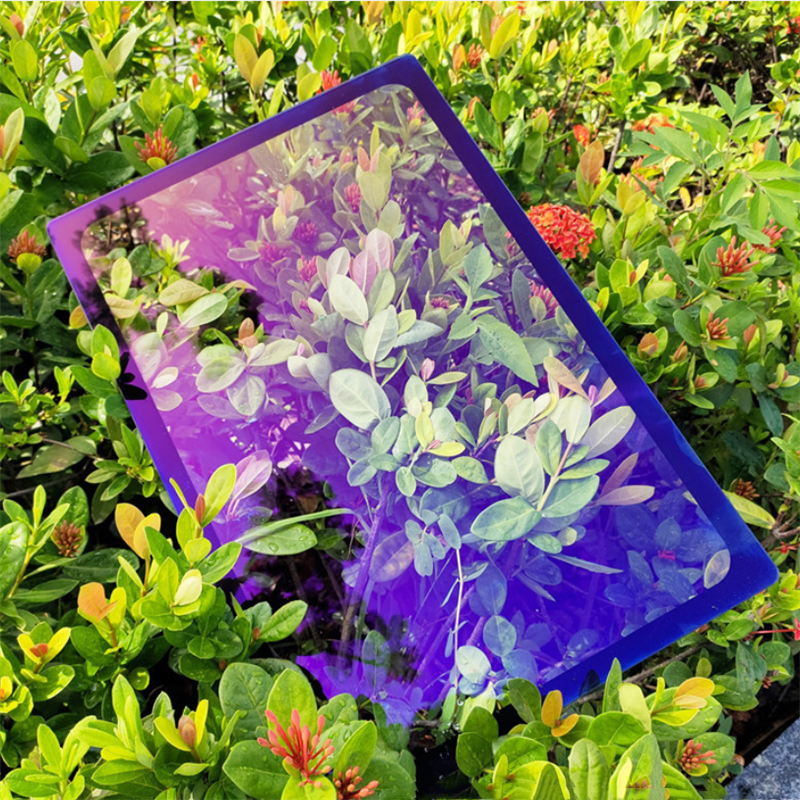

Custom AR Coating Glass Panels & High-Transmission Substrates
1. Product Overview & Optical Highlights
Chenshi Tech specializes in engineering and thin-film deposition of custom AR coating glass (anti-reflective coating glass) panels. Utilizing magnetron sputtering and electron-beam physical vapor deposition, our optical dielectric coatings minimize surface reflection and dramatically enhance light throughput across visible and near-infrared spectrums.
Depending on application requirements, we provide single-sided AR coating achieving visible light transmittance (VLT) exceeding 94.5%, and double-sided AR coating glass reaching over 98.5% transmittance. While raw quartz and borosilicate substrates inherently deliver around 92% transmission, applying our optical AR thin films eliminates surface glare and ensures maximum optical efficiency.
Complementing our custom borosilicate 3.3 glass panels and high-precision optical quartz glass plates, our custom AR coating glass provides high-efficiency anti-glare clarity for electronic displays, facial recognition scanners, automotive consoles, and optical equipment viewports.
2. Technical Specifications for AR Coating Glass
All spectral transmission and surface abrasion tolerances conform to international flat glass and optical coating standards, including ISO 9211 for optical coatings.
-
Product Name: Custom Anti-Reflective (AR) Coating Glass Panel
-
Optical Coating Types: Single-Sided AR Coating / Double-Sided AR Coating (Multi-layer dielectric thin film)
-
Single-Sided AR Transmittance: Greater than 94.5% (across 380 nm to 780 nm)
-
Double-Sided AR Transmittance: Greater than 98.5% (peak transmission up to 99%)
-
Uncoated Base Glass Transmittance: Approximately 91.5% to 92% (for high-purity quartz and borosilicate)
-
Surface Reflectance: Reduced to under 0.5% per coated surface
-
Available Substrate Materials: Ultra-Clear Low-Iron Float Glass, High Borosilicate 3.3, Optical Quartz Glass (JGS1/JGS2), and Chemically Strengthened Aluminosilicate Glass
-
Standard In-Stock Thicknesses: 1.1 mm, 1.6 mm, 1.8 mm, 2.0 mm, 3.0 mm
-
Custom Machinable Thickness Range: 0.1 mm to 10.0 mm (Ultra-thin sensor covers to heavy-duty observation plates)
-
Dimensional Machining Tolerance: Plus or minus 0.05 mm (High-precision CNC cutting and edge milling)
-
Surface Hardness: 7H to 9H Pencil Hardness / Mohs 6.5
-
Environmental Resistance: Passes MIL-C-675C tape adhesion, humidity resistance, and salt spray testing
-
Secondary Edge Treatments: 2.5D C-edge beveling, pencil round polished, flat ground edges, and stepped rabbit ledges
3. Engineering Advantages of AR Coating Glass
-
Unmatched Optical Transmittance: By depositing alternating layers of high and low refractive index dielectric materials, our AR coating glass destroys destructive surface reflections. Double-sided coating boosts visible light throughput from 92% to over 98.5%, delivering bright image projection and vivid display readability.
-
Broad Material Compatibility: We coat a diverse spectrum of substrates. From thermally resilient borosilicate 3.3 glass and ultra-pure UV fused silica quartz to ultra-thin flexible float glass, the coating exhibits robust mechanical adhesion and thermal endurance.
-
Glare Elimination and Visual Comfort: In outdoor sunlight and high-ambient lighting environments, untreated glass causes harsh specular reflections that obscure screens and sensors. Our AR treatment cuts surface reflectance to under 0.5%, ensuring rapid optical scanning and eye fatigue relief.
4. Core Applications & Industry Use Cases
-
Display Protection Screens: High-end screen protective glass, ruggedized outdoor monitors, and commercial interactive touch kiosks.
-
Touch Display Panels: Industrial HMI operator terminals, banking ATM interfaces, and smart home appliance touch consoles.
-
Electrical & Switch Panels: Luxury smart touch wall switches, architectural control faceplates, and digital indicator panels.
-
Facial Recognition & Biometric Scanners: Security turnstiles, optical fingerprint readers, biometric facial recognition cameras, and access control terminals.
-
Automotive Center Consoles: In-vehicle navigation displays, digital instrument clusters, head-up display (HUD) combiner glass, and electronic rearview mirror covers.
-
Optical Equipment Viewing Windows: Industrial process inspection viewports, laser protection windows, camera sensor filter plates, and laboratory spectrometer viewports.
5. Frequently Asked Questions (FAQ)
Q: What is the primary difference in performance between single-sided and double-sided AR coating?
A: Single-sided AR coating reduces reflection on one glass surface, boosting overall visible transmittance to over 94.5%. Double-sided AR coating eliminates reflection on both internal and external surfaces, maximizing total light transmission to greater than 98.5%. Double-sided coating is recommended for high-precision sensor viewports and outdoor optical displays.
Q: How does base substrate selection affect the final transmittance of AR coating glass?
A: High-purity base substrates such as optical quartz glass and borosilicate 3.3 glass have lower internal bulk absorption and an uncoated transmittance around 92%. When coated with broadband AR thin films, they achieve peak transmission up to 99% across wide spectral bands.
Q: What thicknesses can you fabricate for custom AR coating glass?
A: We provide standard in-stock thicknesses between 1.1 mm and 3.0 mm for immediate CNC sizing, and fully support custom processing across the complete range of 0.1 mm ultra-thin cover plates up to 10.0 mm heavy-duty viewing windows.
Q: Can AR coating be combined with Anti-Fingerprint (AF) oleophobic treatments?
A: Yes. We frequently manufacture dual-treatment “AR + AF” panels. The AR layer delivers maximum optical clarity (>98%), while the hydrophobic AF topcoat provides an easy-to-clean water contact angle over 115 degrees, repelling oils, fingerprints, and smudges.


