

When optical engineers, biomedical researchers, and device developers select transparent substrates for precision laboratory testing, conventional float glass is rarely the first choice. Standard soda-lime silicate glass often compromises sensitive experiments through ionic contamination and background optical noise, while high borosilicate alternatives present fabrication challenges in nanoscale microfluidics.
In response, Corning Eagle XG glass has established itself as the global gold standard for bio-analytical diagnostics, confocal fluorescence microscopy, microfluidic lab-on-a-chip (LoC) devices, and optoelectronic research.
Produced using Corning’s proprietary overflow fusion draw technology, this specialized alkaline earth boro-aluminosilicate glass achieves atomic-level surface smoothness straight from the draw without requiring mechanical pitch polishing. This engineering guide details the chemical composition, optical dispersion, thermal properties, and fabrication capabilities that make Corning Eagle XG glass indispensable across advanced research environments.
1. Core Material & Mechanical Properties
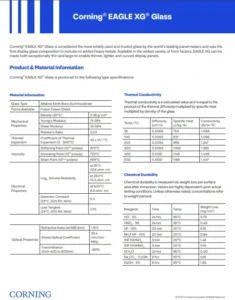
| Parameter / Property Category | Engineering Metric / Specification | Official Corning Eagle XG Glass Standard |
| Material Formulation Matrix | Chemical Base Composition | Alkaline Earth Boro-Aluminosilicate |
| Primary Sheet Forming Method | Manufacturing Process | Overflow Fusion Draw (Mid-Air Draw) |
| Density | Measured at 20°C | 2.38 g/cm³ |
| Young’s Modulus | Tensile Elastic Modulus | 74 GPa |
| Shear Modulus | Torsional Rigidity Modulus | 30 GPa |
| Poisson’s Ratio | Lateral Contraction Ratio | 0.23 |
| Coefficient of Thermal Expansion (CTE) | Linear Expansion (0°C to 300°C) | 32 × 10⁻⁷ / °C |
| Strain Point | Viscosity: 10^14.5 poises | 669°C |
| Annealing Point | Viscosity: 10^13 poises | 722°C |
| Softening Point | Viscosity: 10^7.6 poises | 972°C |
2. Optical and Electrical Performance Profile
| Property Category | Testing Metric / Operating Condition | Standard Value / Specification |
| Optical Refractive Index | Sodium D-Line (nd @ 589.3 nm) | 1.510 |
| Stress Optical Coefficient | Mechanical Birefringence Factor | 33.4 nm/cm/MPa |
| Luminous Transmittance | Spectral Wavelength (400 nm to 800 nm) | Greater than 90% |
| Dielectric Constant | Condition: 23°C, 20% RH, 1 kHz | 5.3 |
| Loss Tangent (Dissipation Factor) | Condition: 23°C, 20% RH, 1 kHz | 0.1% |
| Volume Resistivity (Log10) | Room Temperature (at 25°C) | 23.6 ohm·cm |
| Volume Resistivity (Log10) | Elevated Temperature (at 250°C) | 13.3 ohm·cm |
| Volume Resistivity (Log10) | High Temperature (at 500°C) | 8.9 ohm·cm |
3. Thermal Conductivity Profile Across Temperatures
Thermal conductivity is calculated as the product of thermal diffusivity, specific heat capacity, and glass density:
| Temperature (°C) | Thermal Diffusivity (cm²/s) | Specific Heat Capacity (J/kg·°K) | Thermal Conductivity (W/m·°K) |
| 25°C | 0.0059 | 753 | 1.058 |
| 100°C | 0.0055 | 831 | 1.098 |
| 200°C | 0.0054 | 969 | 1.247 |
| 300°C | 0.0053 | 1093 | 1.365 |
| 400°C | 0.0051 | 1148 | 1.409 |
| 500°C | 0.0051 | 1189 | 1.447 |
4. Chemical Durability & Weight Loss Resistance
Chemical durability is evaluated by surface weight loss per unit area after exposure to concentrated solutions:
| Chemical Reagent & Concentration | Exposure Time | Test Bath Temperature | Surface Weight Loss (mg/cm²) |
| Hydrochloric Acid (HCl – 5%) | 24 hours | 95°C | 0.79 |
| Nitric Acid (HNO3 – 1M) | 24 hours | 95°C | 0.49 |
| Hydrofluoric Acid (HF – 10%) | 20 minutes | 20°C | 5.18 |
| Ammonium Fluoride Mixture (NH4F:HF – 10%) | 20 minutes | 20°C | 0.84 |
| Acid Etch Solution (1HF : 10HNO3) | 3 minutes | 20°C | 1.48 |
| Dilute Acid Solution (1HF : 100HNO3) | 3 minutes | 20°C | 0.16 |
| Deionized Water (DI H2O) | 24 hours | 95°C | 0.00 (Zero mass loss) |
| Sodium Carbonate (Na2CO3 – 0.02N) | 6 hours | 95°C | 0.16 |
| Sodium Hydroxide (NaOH – 5%) | 6 hours | 95°C | 1.83 |
5. Why Corning Eagle XG Glass Excels in Laboratory Applications
Zero Alkali Leaching for Biocompatibility
Standard soda-lime glass contains sodium oxide and potassium oxide that leach into aqueous testing buffers, shifting solution pH, altering enzyme reaction rates, or denaturing proteins. Corning Eagle XG is formulated as an alkali-free boro-aluminosilicate (alkali content below 0.1 wt%). It provides absolute chemical neutrality, preventing ionic contamination in patch-clamp testing, DNA microarrays, and cell culture studies.
Sub-Nanometer Native Surface Smoothness
Formed in mid-air via the overflow fusion process, Eagle XG cools without touching molten metal beds or rolling dies. With a pristine native surface roughness (Ra) under 0.2 nm to 0.5 nm, it offers exceptional flatness for hermetic thermal compression bonding with silicon wafers and oxygen-plasma-activated PDMS chips in microfluidics.
Low Autofluorescence & Optical Index Matching
At 589.3 nm, its refractive index of 1.510 reduces Fresnel reflection losses compared to conventional float glass. Under laser excitation (365 nm, 405 nm, and 488 nm), it demonstrates virtually undetectable background autofluorescence, ensuring optimal signal-to-noise clarity in confocal microscopy.
6. Primary Research & Diagnostic Use Cases
-
Microfluidic Lab-on-a-Chip (LoC) Devices: Defect-free channels and high bonding seal integrity for biochemical fluid transport.
-
Transparent Sensing Electrodes: High thermal stability (annealing point of 722°C) makes Eagle XG an ideal substrate for sputtering transparent conductive coatings, including precision ITO conductive glass substrates, for electrochemical sensors and bio-MEMS.
-
Genomic Sequencing Flow Cells: Flatness and high optical transmission (over 90%) allow consistent focus tracking across multi-channel laser flow chambers.
7. Custom Precision Machining & Cleanroom Fabrication
While Corning supplies standard master sheets, integrating Corning Eagle XG Glass into specialized instruments requires precision secondary fabrication. Chenshi Tech provides end-to-end CNC machining to CAD drawings:
-
Ultra-Thin CNC Profiling: Diamond-tooled cutting across standard thicknesses (0.4 mm, 0.5 mm, 0.7 mm, and 1.1 mm) with profile tolerances within plus or minus 0.05 mm.
-
Safety Edge Chamfering: 45-degree micro-arrises, 2.5D round pencil edges, and optical flat polishing to eliminate edge micro-cracks and flaws.
-
Ultrasonic & Laser Micro-Drilling: Precision fluidic inlet/outlet ports, micro-hole arrays, and stepped vacuum sealing profiles without edge chipping.
-
Optical Thin-Film Coatings: Single- and double-sided anti-reflective (AR) coatings for high visible transmission, transparent conductive ITO circuits, and oleophobic AF finishes.

Frequently Asked Questions (FAQ)
Q: Can Corning Eagle XG glass be chemically strengthened?
A: Unlike Corning Gorilla Glass, Eagle XG contains virtually zero mobile alkali ions (sodium or potassium). Chemical tempering requires ion-exchange in molten KNO3 baths, meaning Eagle XG cannot be chemically strengthened. Its mechanical durability relies instead on its native draw surface and precision CNC safety edge grinding.
Q: How does Corning Eagle XG Glass compare to Borosilicate 3.3 in laboratory settings?
A: Borosilicate 3.3 is ideal for bulk high-temperature resistance up to 450°C, but contains trace alkali oxides and typically exhibits higher surface roughness unless mechanically polished. Corning Eagle XG provides superior sub-nanometer surface smoothness straight from the draw, zero alkali leaching, and negligible autofluorescence for optical sensing.
Q: What standard sheet thicknesses are available for custom fabrication?
A: Eagle XG is processed in ultra-thin formats, including 0.4 mm, 0.5 mm, 0.7 mm, and 1.1 mm. Custom discs, square slides, and perforated flow cells can be cut directly to CAD drawing specifications.