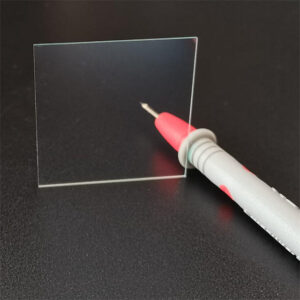
Customizing transparent conductive oxide (TCO) glass—specifically Indium Tin Oxide (ITO) and Fluorine-Doped Tin Oxide (FTO)—requires clear engineering parameters to balance electrical conductivity, optical transmittance, and thermal stability. When requesting a precision fabrication quote from Chenshi Tech, specifying the following core parameters ensures fast prototyping and exact functional performance:
-
Substrate Base Material & Working Temperature:
-
ITO Glass: Deposited on soda-lime float glass or Corning Eagle XG boro-aluminosilicate. It delivers high visible light transmittance (>86%) and ultra-low surface roughness (Ra < 1.2 nm), ideal for touchscreens, OLED displays, and transparent heating elements operating under 300°C.
-
FTO Glass: Deposited via chemical vapor deposition on high-clarity float glass. It withstands furnace sintering up to 550°C to 600°C and resists aggressive acid electrolytes, making it the premier choice for perovskite solar cells, dye-sensitized solar cells (DSSC), and electrochemical electrodes.
-
-
Target Sheet Resistance (Rs) & Thickness:
-
Low Resistance (5 to 10 ohm/sq): Engineered for transparent heating windows, defogging viewports, and high-efficiency photovoltaic electrodes.
-
Standard Conductive Range (10 to 15 ohm/sq): The industry standard for optoelectronic devices, capacitive touch sensors, and electrochemical testing.
-
High Resistance (30 to 100+ ohm/sq): Utilized where maximum optical transparency (>88%) and thin-film uniformity are paramount.
-
-
Substrate Thickness & Dimensional Tolerances:
-
Available standard thicknesses for ITO glass include 0.4 mm, 0.55 mm, 0.7 mm, 1.1 mm, 1.8 mm, and 2.2 mm.
-
Standard thicknesses for FTO glass include 1.1 mm, 1.6 mm, and 2.2 mm.
-
Precision CNC diamond wheel edging delivers profile tolerances within ±0.05 mm (or up to ±0.02 mm for custom laser routing).
-
-
Optical Transmittance & Haze Requirements:
-
Specify whether your application requires Low Haze (<0.5% for crystal-clear display viewports) or High Haze (>10% to 15% on FTO substrates to create light-trapping effects in solar energy harvesting).
-
-
Electrode Patterns & Busbar Terminations:
-
Laser Scribing & Etching: We provide P1, P2, and P3 isolation lines (kerf widths under 25–30 microns) or photolithographic wet chemical etching for complex multi-channel circuit traces.
-
Busbars & Wiring: Thermally fired high-conductivity silver ceramic paste or copper mesh busbars applied along opposing borders, supplied with pre-soldered lead wires or FPC connectors.
-
Explore our technical specifications for custom ITO conductive glass substrates and FTO conductive glass substrates to match your project specifications.